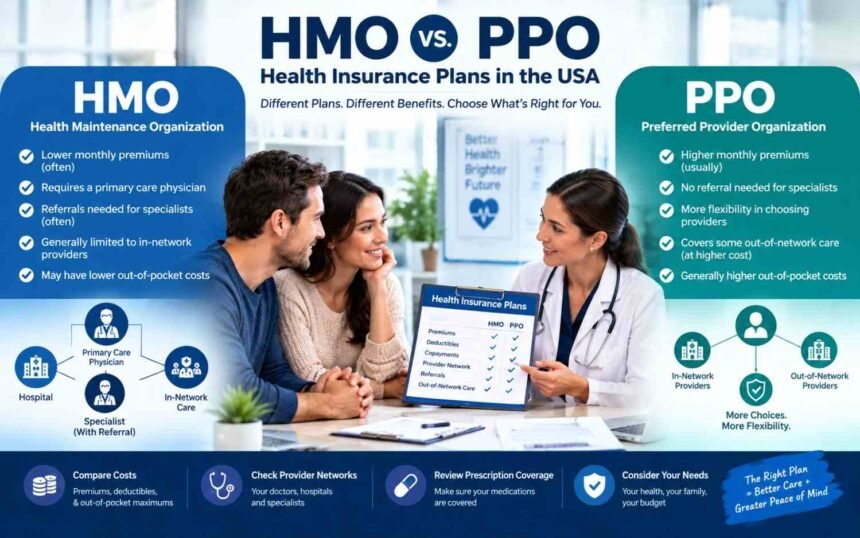
- What Is an HMO Health Insurance Plan?
- What Is a PPO Health Insurance Plan?
- HMO vs. PPO: What’s the Difference?
- Is HMO Cheaper Than PPO?
- 1. Monthly Premiums
- 2. Deductibles
- 3. Copayments and Coinsurance
- 4. Out-of-Pocket Maximums
- 5. Out-of-Network Costs
- Which Is Better: HMO or PPO?
- HMO vs. PPO for Families
- HMO vs. PPO for People With Chronic Conditions
- Can You See a Specialist Without a Referral?
- How to Choose the Right Health Insurance Plan
- Step 1: List Your Healthcare Needs
- Step 2: Check Your Preferred Doctors
- Step 3: Compare Total Costs
- Step 4: Review Prescription Benefits
- Step 5: Read the Plan Documents
- Step 6: Check Financial Assistance
- Step 7: Make a Decision Based on Your Priorities
- Frequently Asked Questions
- Is HMO better than PPO?
- Why are PPO plans often more expensive?
- Do HMO plans cover emergency room visits outside the network?
- Can I change from an HMO to a PPO?
- Does a PPO cover out-of-network doctors?
- Which plan is better for someone who rarely visits a doctor?
- Can I get an HMO or PPO through my employer?
- Final Verdict: HMO or PPO?
Choosing a health insurance plan can feel overwhelming, especially when you encounter terms such as HMO and PPO. Both are common types of health insurance plans in the United States, but they differ in how you access healthcare, choose doctors, and pay for medical services.
For some people, an HMO plan offers an affordable way to manage healthcare expenses. Others may prefer a PPO because it generally provides more flexibility when choosing healthcare providers.
However, the best option is not necessarily the plan with the lowest monthly premium or the largest provider network. Your healthcare needs, budget, preferred doctors, prescription medications, and expected medical expenses should all influence your decision.
Understanding the differences between HMO and PPO health insurance can help you select a plan that fits your lifestyle while avoiding unnecessary healthcare costs.
In this guide, we explain how HMO and PPO plans work, compare their costs and benefits, and highlight what you should consider before enrolling.
What Is an HMO Health Insurance Plan?
HMO stands for Health Maintenance Organization.
An HMO plan generally provides coverage through a network of doctors, hospitals, specialists, and other healthcare providers who have agreed to work with the insurance company.
Members typically select a primary care physician who helps coordinate their healthcare. Depending on the plan, you may need a referral from your primary care physician before visiting a specialist.
HMO plans generally do not cover routine care received outside the network, except in certain circumstances, such as emergencies or when other applicable coverage rules provide an exception.
Because these plans focus on a defined provider network, they may offer lower premiums or other cost advantages compared with some PPO plans. However, pricing varies by insurer, location, and plan design.
How Does an HMO Plan Work?
When you enroll in an HMO plan, you generally receive care through the plan’s approved network.
For example, if you need treatment for a recurring health concern, you might first visit your primary care physician. If specialist care is necessary, your doctor may refer you to a specialist within the network.
You then pay the applicable copayment, coinsurance, or deductible under your policy.
The exact process depends on the plan. Some services may require referrals or prior authorization, while others may not.
Before enrolling, check whether your preferred doctors, nearby hospitals, and relevant specialists participate in the specific HMO network.
Advantages of HMO Health Insurance
Potentially lower premiums: Some HMO plans have lower monthly premiums than comparable PPO plans.
Coordinated healthcare: A primary care physician can help organize treatment and referrals when needed.
Defined provider network: The network can make it easier to understand where you can receive covered routine care.
Potentially lower out-of-pocket expenses: Depending on the plan, copayments and other cost-sharing requirements may be relatively affordable.
Disadvantages of HMO Health Insurance
Limited provider flexibility: You generally need to use in-network providers for routine covered care.
Referral requirements: Some HMO plans require referrals before you can see specialists.
Potential challenges when traveling: Routine care outside the network may not be covered, although emergency care and certain other services may be treated differently under applicable rules.
Network limitations: Your preferred doctor or hospital may not participate in the plan.
An HMO may be a good option if you are comfortable with its provider network and want a plan that emphasizes coordinated care.
What Is a PPO Health Insurance Plan?
PPO stands for Preferred Provider Organization.
A PPO plan also uses a network of healthcare providers, but it generally gives members more flexibility to seek care outside that network.
You can typically visit in-network specialists without obtaining a referral from a primary care physician, although particular services may still require prior authorization.
PPO plans also commonly cover certain out-of-network services. However, you will usually pay more for that care, and some expenses may not count toward the same out-of-pocket limits that apply to in-network services.
Out-of-network providers may also bill you for amounts above the insurer’s allowed payment, subject to applicable federal and state protections.
PPO plans can be attractive to people who want greater freedom to choose doctors or who need access to specialists across different healthcare systems.
How Does a PPO Plan Work?
Suppose you need to consult a dermatologist.
With a PPO plan, you can generally schedule an appointment with an in-network dermatologist without a referral, subject to the plan’s rules.
If you choose an out-of-network dermatologist, the plan may cover part of the eligible expense. However, your deductible and coinsurance may be higher, and you could face additional costs.
For example, consider a hypothetical covered service with an allowed amount of $300.
If your in-network coinsurance is 20%, you would generally pay $60 after satisfying the applicable deductible.
If your out-of-network coinsurance is 40%, you would generally pay $120 toward the same $300 allowed amount, potentially plus any deductible and any amount the provider is legally permitted to bill beyond the allowed payment.
These figures are illustrative only. Actual costs depend on the policy, provider agreement, and applicable billing protections.
Advantages of PPO Health Insurance
Greater provider flexibility: You can generally receive covered care from both in-network and out-of-network providers.
Fewer referral requirements: Many PPO plans allow direct access to specialists without a primary care referral.
Useful for specialist care: PPO coverage may be attractive if you regularly consult specialists across different healthcare systems.
More options when traveling: A PPO may provide additional choices for covered nonemergency care outside your local area, depending on the network and policy.
Disadvantages of PPO Health Insurance
Potentially higher premiums: PPO plans may cost more each month than comparable HMO plans.
Higher out-of-network costs: Deductibles and coinsurance may be substantially higher outside the network.
Possible balance billing: Out-of-network providers may charge more than the insurer’s allowed amount, subject to applicable protections.
More complicated cost comparisons: You may need to review separate in-network and out-of-network deductibles, limits, and reimbursement rules.
A PPO may be worth considering if flexibility is a high priority and you can afford the associated premiums and potential out-of-pocket expenses.
HMO vs. PPO: What’s the Difference?
The main difference between HMO and PPO health insurance is how much flexibility you have when accessing healthcare providers.
Here is a side-by-side comparison.
| Feature | HMO Health Insurance | PPO Health Insurance |
|---|---|---|
| Full form | Health Maintenance Organization | Preferred Provider Organization |
| Provider network | Generally more restrictive | Generally more flexible |
| Primary care physician | Often required or central to care coordination | May be optional |
| Specialist referrals | Often required | Generally not required |
| Out-of-network routine care | Generally not covered, subject to exceptions | Often covered at a higher cost |
| Monthly premiums | May be lower | May be higher |
| Out-of-network expenses | Usually limited coverage | Often higher cost-sharing |
| Provider choice | More restricted | Generally broader |
| Care coordination | Often emphasizes coordinated care | May allow more independent provider selection |
| Best suited for | People comfortable with a defined network | People who value provider flexibility |
These are general characteristics, not guarantees. Individual policies can differ, so always review the plan’s actual benefits and coverage rules.
Is HMO Cheaper Than PPO?
HMO plans are often less expensive than PPO plans, but this is not always the case.
Your actual costs depend on the insurer, location, plan design, deductible, healthcare needs, and whether you qualify for financial assistance.
To compare plans fairly, consider five major expenses.
1. Monthly Premiums
The premium is the amount you pay to maintain coverage.
A lower-premium HMO may help you manage monthly expenses, particularly if you do not expect to need frequent medical care.
However, a low premium does not automatically mean lower total healthcare spending.
2. Deductibles
Your deductible is the amount you generally pay for covered services subject to the deductible before your insurer begins paying its share.
Some plans have relatively low deductibles but higher premiums. Others have lower premiums and higher deductibles.
Compare these amounts alongside your expected healthcare use.
3. Copayments and Coinsurance
Copayments are fixed amounts you pay for certain covered services. Coinsurance is the percentage of eligible costs you pay under the policy.
An HMO might offer affordable primary care visits, while a PPO might provide more provider choices at a higher overall cost.
Check the specific amounts for primary care, specialist visits, hospital care, and prescription medications.
4. Out-of-Pocket Maximums
The out-of-pocket maximum limits qualifying spending on covered in-network essential health benefits during the plan year, subject to applicable rules.
Once you reach the applicable limit, the plan generally pays 100% of covered in-network essential health benefit costs for the remainder of the plan year.
Monthly premiums, noncovered services, and certain out-of-network expenses generally do not count toward this limit.
If you anticipate substantial medical expenses, comparing out-of-pocket maximums is particularly important.
5. Out-of-Network Costs
This is one of the biggest differences between many HMO and PPO plans.
If you receive routine care outside an HMO’s network, the plan generally will not cover it unless an exception applies.
A PPO may provide some coverage for out-of-network services, but you could face higher deductibles, higher coinsurance, and additional provider charges.
Before choosing a plan, consider whether you are likely to use out-of-network providers.
Which Is Better: HMO or PPO?
There is no single answer for every American household.
The better option depends on your medical needs, financial situation, and preferences.
An HMO May Be Better If You:
- Want to keep your monthly premiums manageable.
- Are comfortable selecting a primary care physician.
- Prefer receiving care through a coordinated provider network.
- Have access to suitable doctors and hospitals within the network.
- Rarely need nonemergency care outside your local area.
- Are comfortable following the plan’s referral and authorization rules.
For example, a healthy individual who lives near several participating doctors and wants predictable access to routine care may find an HMO appealing.
A PPO May Be Better If You:
- Want greater flexibility when choosing healthcare providers.
- Prefer visiting specialists without obtaining referrals.
- Already have doctors who are outside some HMO networks.
- Need access to multiple healthcare systems.
- Frequently travel and want additional options for covered nonemergency care.
- Can afford potentially higher premiums and out-of-network expenses.
For example, a family that wants to continue seeing specialists at different medical centers may prefer a PPO if those providers are not all available through a suitable HMO.
Remember that a PPO does not guarantee coverage for every provider or treatment. Network participation, benefit exclusions, and authorization requirements still matter.
HMO vs. PPO for Families
Families should evaluate health insurance plans based on the needs of every covered household member.
Parents may prioritize pediatricians, preventive care, prescription medications, and access to nearby hospitals.
Families with children who need specialist treatment may place greater importance on provider networks and referral requirements.
A plan that works well for one parent may not be the best option for the entire household.
Before enrolling, check the following:
- Are your children’s pediatricians in the network?
- Are nearby hospitals and urgent care centers covered?
- Are your regular prescriptions included in the formulary?
- Does the plan cover the specialists your family may need?
- What are the individual and family deductibles?
- What is the family out-of-pocket maximum?
- Does the plan have referral or prior authorization requirements?
If an employer offers multiple health insurance options, compare the total annual cost of family coverage rather than focusing only on the employee’s individual premium.
HMO vs. PPO for People With Chronic Conditions
People managing ongoing health conditions may need regular appointments, prescription medications, diagnostic tests, and specialist care.
For these individuals, the provider network can be just as important as the monthly premium.
An HMO may work well if the required doctors and facilities are in-network and the referral process fits the patient’s needs.
A PPO may offer more flexibility if the patient sees several specialists or wants access to providers outside a particular network.
However, the plan name alone cannot determine which option will provide better coverage.
Before enrolling, verify the following:
Specialist availability: Confirm that the specialists you need are covered under the specific plan.
Prescription coverage: Check the formulary, medication tiers, deductibles, and applicable copayments or coinsurance.
Treatment coverage: Review the rules for relevant procedures, diagnostic tests, and ongoing therapies.
Prior authorization: Determine whether particular treatments or medications require advance approval.
Total costs: Compare premiums, deductibles, coinsurance, and out-of-pocket maximums.
If you are receiving ongoing treatment, verify coverage before switching plans to avoid unexpected costs or disruptions.
Can You See a Specialist Without a Referral?
Whether you need a referral depends on your specific health insurance plan.
Many HMO plans require a referral from a primary care physician before you visit certain specialists. Some plans have exceptions or do not require referrals for particular services.
PPO plans generally allow members to visit in-network specialists without a primary care referral, although prior authorization may still be required for certain treatments.
A referral and prior authorization are different.
A referral typically directs you to another healthcare professional. Prior authorization is an insurer’s advance review of whether a particular service, treatment, or medication meets the plan’s coverage requirements.
Before scheduling specialist care, check the rules for your specific plan.
How to Choose the Right Health Insurance Plan
Whether you choose an HMO or PPO, following a structured comparison process can help you avoid costly mistakes.
Step 1: List Your Healthcare Needs
Think about how often you visit doctors, whether you need specialist care, and which medications you regularly take.
Consider the healthcare needs of everyone who will be covered under the policy.
Step 2: Check Your Preferred Doctors
Use the insurer’s provider directory to determine whether your doctors, specialists, and preferred hospitals participate in the network.
Confirm the information with the insurer and provider, because directories may not always reflect recent changes.
Step 3: Compare Total Costs
Calculate the annual premiums and consider likely deductibles, copayments, coinsurance, and out-of-network expenses.
Review the out-of-pocket maximum to understand the limits on qualifying covered expenses.
Step 4: Review Prescription Benefits
Make sure the medications you use are covered and understand the applicable cost-sharing requirements.
Check whether you must use specific pharmacies or obtain prior authorization.
Step 5: Read the Plan Documents
Review the Summary of Benefits and Coverage, provider directory, prescription formulary, and relevant policy documents.
Pay particular attention to exclusions, referrals, prior authorization, and emergency care provisions.
Step 6: Check Financial Assistance
If you are purchasing individual coverage, investigate whether you qualify for Marketplace premium tax credits or cost-sharing reductions.
Eligibility depends on your circumstances and applicable rules.
You can compare Marketplace plans through the official HealthCare.gov website.
Step 7: Make a Decision Based on Your Priorities
If you value affordability and are comfortable with a defined network, an HMO may be a good fit.
If you value flexibility and want more options for out-of-network care, a PPO may be worth considering.
Choose based on the actual benefits and costs rather than the plan label alone.
Frequently Asked Questions
Is HMO better than PPO?
Neither is universally better. HMO plans may provide an affordable option for people comfortable with a defined provider network, while PPO plans generally offer more flexibility. The right choice depends on your healthcare needs, preferred doctors, budget, and plan details.
Why are PPO plans often more expensive?
PPO plans may charge higher premiums because they generally provide greater flexibility, including coverage options for certain out-of-network services. However, prices vary, and not every PPO costs more than every HMO.
Do HMO plans cover emergency room visits outside the network?
Emergency care is subject to specific federal and state protections and plan rules. HMO members generally should not assume that emergency treatment will be treated like routine out-of-network care. Check your plan documents and applicable protections for details.
Can I change from an HMO to a PPO?
You may be able to change plans during your employer’s enrollment period, the Marketplace Open Enrollment Period, or an applicable Special Enrollment Period. The available options depend on your coverage source and eligibility.
Does a PPO cover out-of-network doctors?
Many PPO plans provide some coverage for out-of-network services, but your costs may be significantly higher. Some services may be excluded, and out-of-network providers may be able to bill additional amounts where permitted by law.
Which plan is better for someone who rarely visits a doctor?
An HMO may be attractive if its premiums are lower and its provider network meets your needs. However, you should still compare deductibles, out-of-pocket maximums, and coverage for unexpected medical expenses.
Can I get an HMO or PPO through my employer?
Yes. Many employers offer one or more health insurance plan options, which may include HMO and PPO plans. The choices available depend on the employer and its insurance arrangements.
Final Verdict: HMO or PPO?
HMO and PPO health insurance plans can both provide valuable coverage, but they are designed around different approaches to accessing healthcare.
An HMO may suit people who want a more structured provider network and potentially lower premiums. A PPO may be a better fit for those who prioritize flexibility when choosing doctors and accessing covered out-of-network care.
Before enrolling, compare premiums, deductibles, provider networks, prescription drug coverage, and out-of-pocket maximums.
Most importantly, make sure your preferred healthcare providers and necessary treatments are covered under the specific plan you choose.
The best health insurance plan is the one that balances your budget with access to the healthcare services you need.